Search This Blog

Tuesday, October 29, 2013

Stupid, stupid and more stupid, or…

Stupid, stupid and more stupid, or “Hey, Apple, wanna know what I want?”

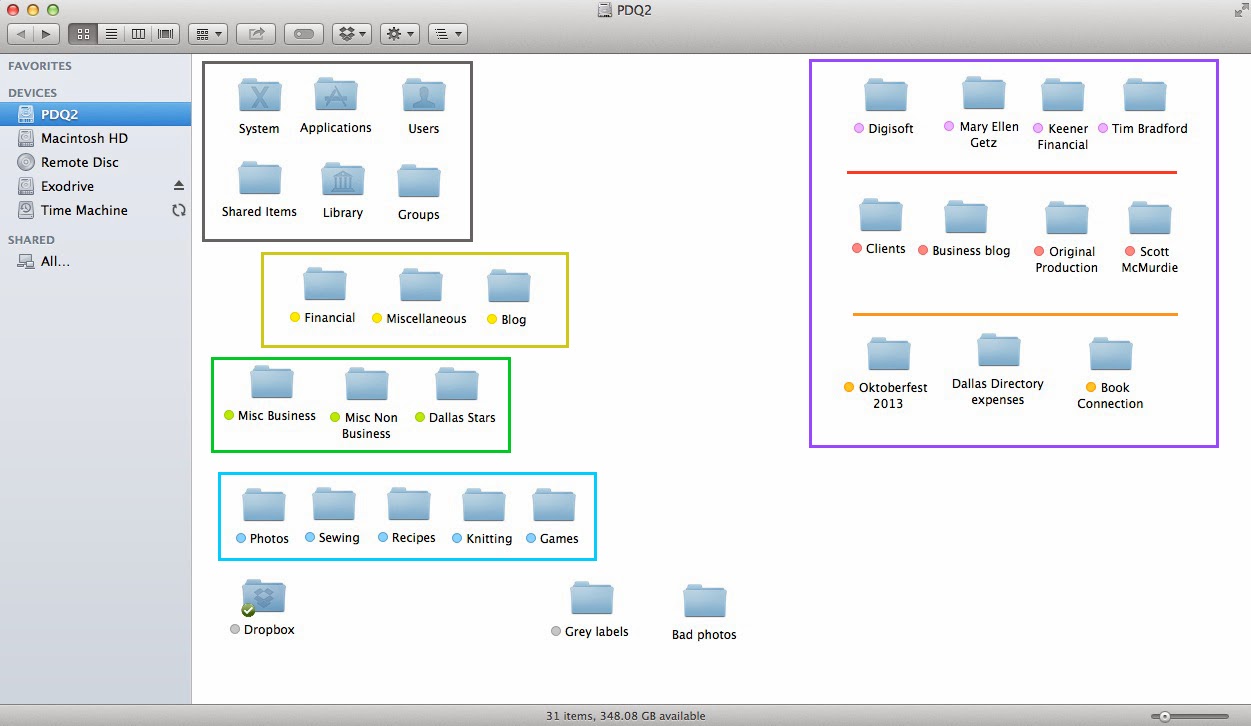
I want dividers for icons. I want to have my hard drive window open, and have it divided into different groups.

Well, really, before we even get to that, I want your freakin’ OS to stop rearranging my icons at random for no apparent reason. I want that a lot.

I have my hard drive window arranged by function, do you hear me, function. Not alphabetically, by date, by size, by anything else, except how I use them. Revolutionary idea, I know. And for the last year or so, at unpredictable intervals, the window just rearranges itself, usually alphabetically. And before any smug, superior smartass suggests it: yes, I have both “arrange by” and “sort by” set to “None.” NONE, dammit!

For a while it got a little better, or at least a little easier to recover from that stupid, stupid bug (yeah, I’m going to charitably assume it’s a bug and not just that you think you know better than I do how I need it organized). I used different color tags for the different groups, so I could see at a glance how to undo your stupid rearrangement. So I could enlarge the window, move everything out of the way and just start re-sorting. But now, with “Mavericks” (and that is a godawful stupid name, BTW), the tags are little bitty dots beside the folder name. So it’s much harder to see it at a glance. Much harder to recover from your recurring bug. Mission accomplished, Apple!

Okay. Now, then. Anyway…I want to have dividers so that I can group files and folders by function and keep them separate. Right now it looks like this:

I want it to look like this:

Or this:

Or even this:

Can somebody tell me why this isn't possible?

(And stop rearranging my icons!)

Sunday, October 27, 2013

How close is Monday?

The late, great Shari Lewis talked about something she learned from her father. He always said, "The day begins the night before." She went on to say that he was telling her that she had a choice about what the next day would be like, how it would go, by being ready for it—getting a good night's sleep, having her homework done, having everything ready to go in the morning, and so on. By being prepared.

Look at any time management system or process—any one at all, just pick your favorite—the one thing it's sure to say is that you need to take a moment before your day begins (some say the night before, some say first thing in the morning) and get organized: decide what you're going to be doing, what priority each task has, etc.

I used to know someone who would take a few minutes on Sunday afternoon to pick out her work clothes for the week. She'd put together outfits, gather accessories, make sure everything was clean and nothing needed attention, all that. Doing that, she saved herself a little anxiety and probably more than a few minutes each morning that week.

Our house actually faces west but let's just call this morning, shall we?
I like to think of myself as too much of a free spirit to be constrained like that, but the truth is that I've never consistently been that organized. Or, maybe, that motivated.

Fact is, some of us (and I do mean us) work better under a little pressure. And I like to tell myself that I use my free time to rejuvenate. Recuperate. Recharge. And that's how I prepare for the week's stress.

(But I'm afraid the reality is that I just enjoy vegging out in front of the TV a little more than I should.)

When does Monday begin for you? What do you do to prepare for the week?

Tuesday, October 22, 2013

Creativity (and how close it is all the time)

If you're involved in doing something creative—like, say, writing—it's important to keep your mind clear and ideas flowing. If you're involved in doing something that might not seem at first glance to be a creative activity—like, maybe, running a business—it's equally as important.

Back in the '70s, some big corporation* came to the conclusion that executives who were creative got all-around better results from their departments. So the company hired a research firm to come up with a way they could identify creative people during the hiring process. The research people went away and did their thing, then came back with a report. Their results: What makes someone creative is the fact that they believe they are.

So that's the first step. Recognize that you're creative.

The next step is to understand that the biggest part of creativity is just being open to ideas. It's not always a brilliant flash, but sometimes just a notion seeping through the noise in your mind, building slowly and finally—if you let it—getting your attention. To help that happen, there are a few things you can do.

Set aside time to think.
That may seem obvious, but how much time did you schedule today to just think about something? Not do research, not outline solutions, just think. Give yourself time, and you'll be surprised how valuable it becomes. It doesn't have to be a big chunk. Set aside ten minutes a day, and you'll discover yourself making a mental list of things to consider during that time. (Which, incidentally, frees up your mind for the other things you're working on in the meantime. Win, times two.)

Make a note of it
Just as having that few minutes set aside can lead you to collect things you want to give some thought, having a place to make notes or keep track of random thoughts, websites that might be useful, articles of interest to you, etc., will make you tend to notice more things that can help the process. App, notebook & pen, voice recorder—whatever form suits you.

Just make sure you review them at some point. Unless having an idea dump gets rid of the clutter and frees up your thoughts, you have to look at the notes you've made to gain the advantage of making them. That might be another good item to put on your calendar, even for just a few minutes a week.

Leave the office
At least get up from your desk. Take a walk, if that's practical; walking outside is even better. A change of scenery can do wonders.

Most of us have experienced the phenomenon of going into another room and not being able to remember why? There's a neurological reason for that. Going through a door has an effect on your brain, kind of telling it to reset and prepare for something new. During your workday, that's something you can put to good use.

Talk to people
Even if you're not specifically talking about what you're doing, interacting with other people does good things to your brain, not to mention your emotional well being. (That's assuming the people you're interacting with aren't asses. Don't hang around asses, and that's a pretty good rule for life in general.) In fact, even if you don't talk at all, but only listen, you'll still be making a connection and introducing new perspectives into your thought process. It helps!

And making connections is what it's all about. That's just another way to describe the creative process, making connections between seemingly unrelated ideas, facts, procedures—or anything else— and coming up with something new and better.

That's something you can work on!


*I've been referring to this anecdote for decades. I really ought to go look up who was involved. I'll let you know when I find out.

Friday, October 18, 2013

How do you promote volunteer stuff?

I facilitate a book group that I absolutely love! It's based on the concepts from Tim SandersLove is the Killer App. In fact, it was founded by someone who had just read the book. We each whatever we want to read, then come to the group and tell everybody about it. We have fascinating discussions, and leave with a list of what we want to read next (or what we should avoid).

It's rewarding, it's a tremendous source of information. And the group is down to four people. When they all show up.

We had a few dozen members when the group first started. That was years ago, and obviously time has passed, and people have come and gone (even some who seemed really committed to it). And those of us who are left kind of take for granted that it'll be there next month, so if it's not completely convenient, it's okay to skip it. After that…well, we'll see. And so we dwindle.

Now I'm going to spend some time promoting the group, trying to build it back up. The question is how?

Besides the cost to my business to spend too much time on other matters (see all those posts about Oktoberfest), I guess the real deciding factor for how much effort I should put into this is how much I get out of it. Okay, got that.

But what does one do—what do you do—to promote things that don't make money? If it's your kid's band candy sales, you offer it to the people around you at work. If it's a community service group, you might depend on the mechanisms already in place reaching the people who are used to supporting it—the Rotary Club website, the school bulletin, the local paper's Community Calendar.

What else do you do? How far do you go with business development techniques when what you're promoting isn't a business?

No, really. I'm asking.

Wednesday, October 16, 2013

What kind of pro can you hire for five bucks?

Do you know about Fiverr? It's all sorts of people offering all sorts of professional (we all hope) services for as little as five bucks. Artists. Actors. Business experts. No, really!

There's a woman who'll review your business plan and give you a few suggestions. Five bucks. A guy who'll give you ten tips to improve your website. Five bucks. A woman who'll give you a 15-minutes life coaching session. A man who'll conduct a 15-minute strategy session. SEO plans, speeches, book covers, proofreading, intros, voice overs, advice on how to dress…anything and everything. Starting at five bucks.

All this may sound like McServices, but these little nuggets are actually a fantastic way to meet and evaluate someone who could help raise your business to the next level. A friend of mine got a logo for his new business, designed and executed brilliantly by someone he found on Fiverr. It cost more than $5, of course, but the $5 sample he got showed him that this was a designer who understood what he wanted — and that he could work with.

So it's brilliant in that sense. Another real positive is that, well, sometimes five dollars' worth is about all you need.

Do you want a nice, professional-sounding voice over for the video clip on your website? Five bucks will get you 150 words or up to thirty recorded seconds of a pro's time (in, incidentally, just about any accent that floats your business boat). Need 30 seconds of something original and copyright-free for your "hold" music? Yup, five bucks. No, I take it back — three 30-second pieces of music for $5.

Did I mention there are reviews?

If you're keeping your business afloat on a shoestring, Fiverr might be just what you need to add a nice, polished touch. And if you've got a service you can sell in small chunks and you need a creative way to find new clients, you'll want to check out the other side of it.

Buyer or seller, it's close to perfect as a way to get to know people and see how well you work together with a commitment but without a big commitment.

Nice.

Monday, October 14, 2013

Letting go is harder than it looks

I'm letting go of Oktoberfest, and it's harder than I expected.

Not the emotional kind of letting go. I've known for weeks that I was going to be bored for a while afterwards. And maybe a little let down, not having people asking me for decisions all day. No big surprises there.

It's the actual wrapping-everything-up-and-turning-it-over part. I can't seem to get everything done.

All I really have left to do is plug the final numbers into the budget spreadsheet. Make a few lists (what signs we have stored, who provided which services) for the reference of next year's crew. Plan a volunteer thank-you event, or, actually, just set the wheels in motion and let other people take care of it. Gather together all the paperwork to turn over to my charming and talented co-chair, so he'll know where it all is next year.

And yet, somehow, I can't get it done.

Without the pressure of a deadline (like, say, 75,000+ people showing up), I seem to have trouble getting going. Huh.

How do you handle after-event followup (besides better than me)?

Tuesday, October 8, 2013

At the risk of repeating myself (if you read my personal blog)

I'm FREEEEE!

Well, almost. I'm still putting together numbers for the budget spreadsheet (we did pretty well), approving invoices, and planning a volunteer thank-you event. Oh! And I spent most of yesterday cleaning up Oktoberfest remnants (actual physical things left lying around) from Town Square, because they're picky that way. (Okay, I'm loathe to mention that the time and effort it took to take note of the broom leaned up against the door outside our staff office and compose an email about it was much greater than what it would have taken to just unlock the door and stuck it inside. But I'm going to think it.)

We had a pretty good crowd, despite rain on Saturday. This was Festival Hall right before the rain.


And Sunday started hot & heavy. I got there at about 11:30, and there were SO many people I wondered if I had remember the starting time (noon) wrong. Nope. They were just there and ready to party. This was the line at one of the food booths. It's all the way across the street.


We don't have any kind of official count of the number of people attending because there's no admission. The ATM company comes up with a number for other events that's been quite accurate, based on the number of transactions. Their estimate is 135,000. Personally, I think we had about 75,000 people who just had no cash with them.

I'm gradually getting back to the real work. Promise!

Saturday, September 14, 2013

A brief pause…

A brief pause while I chair a three-day event for 50,000–75,000 visitors. That is, this.

I'll be back.

Saturday, June 29, 2013

Ten days here, too

It's rare that I can post the same thing on my personal and business blogs, but here's what I have to say today. Apologies if this is more non-business information than you care to read. (For crying out loud, you've been looking at photos of the trees around our driveway. You can handle this.)
As of the end of the Texas Rangers game last night (they won, BTW, though two of their four runs were forced; poor Reds pitcher…), I have ten days without any appointments or meetings or places to be at specific times. Ten days. Nowhere to be.
Well, okay, I have SNB on Thursday, if I want to go, and we'll be doing something on July 3rd, whether Kaboom Town in Addison (at the invitation and office of my fellow Dallas Stars Season Ticket Holder Council member, Gary Ludwig) or at Southlake's Stars and Stripes celebration. That's what we usually do, and I should be there to scope out some new Town-Square-event ideas (they're using food trucks this year!) for Oktoberfest. But our fantastic event planner has agreed to check that out for us, so I'm actually free to go to Gary's do.
If I want. I don't have to go. Anywhere. At all. No, not even to church, because White's Chapel UMC cancels the service I go to (the Founder's Chapel service, aka the Redheaded Stepchild service) at the drop of a hat, especially around holidays like Independence Day.
So it's sleeping 'til I wake up, catching up on laundry, cleaning (the dust bunnies are starting to show signs of life), wading through Oktoberfest stuff and blogging. Lots and lots of blogging. The last few weeks have perfectly illustrated my need to have some blog entries completed and standing by. There are simply going to be periods when my schedule won't allow me to sit down and write anything just for myself. Like most of the 99 days between now and the end of Oktoberfest, for example.
Just a bit of added content for the business blog: My inbox actually got better between the last post and today, but it's once again gotten away from me.


I was going to wait 'til it got to 1,000 unread to do that screen capture, but I need to go change the sheets and sort some laundry and stuff.

See you back here soon, with some actual intelligent business-related content. Promise!

Wednesday, June 19, 2013

Sorry!

Sorry for disappearing for a while. Oktoberfest meetings, Chamber meetings, errands, and…really, why the heck have I been so busy? Huh. Listing it like that, it doesn't sound like I should be so slammed, but here's the way it's actually been the last few days:

Yes, that's 724 unread messages.
I'm seriously considering just deleting everything and starting over. If it's important, they'll write back, right?

(Sorry. Actual intelligent content later.)

Wednesday, June 12, 2013

Good quotes, or tricks for getting things done

I keep a file in Smart Notes of good quotes. I have quite a few, and I add to it pretty regularly. I try to read through it occasionally because, well, otherwise, why am I keeping it?

This one speaks to me right now:
Let this be an example for the acquisition of all knowledge, virtue, and riches. By the fall of drops of water, by degrees, a pot is filled.The Hitopadesa
Some days, the best I can do is about a drop. Nice to think it adds up.

This also inspires me:
No obstacle will ever leave you the way it found you. — Anonymous
And these caution me:
Lots of folks confuse bad management with destiny.Kin Hubbard (1868-1930)
There is nothing more frightful than ignorance in action. Johann Wolfgang von Goethe (1749-1832)
But this is the one that I find I really have to hold on to sometimes:
Anyone can do any amount of work, provided it isn't the work he is supposed be doing at that moment.Robert Benchley, "How to Get Things Done" (from The Algonquin Wits & others)
Robert Benchley
Photo from biography.com
There are days when I the one thing I cannot face doing is the thing that has a deadline about to slap me in the face. As Benchley discusses in his essay, sometimes the best way to get it done is to take the pressure off and put it on something else. Say, for example, I have to write an article about networking. I may start it with the best intentions, but will soon find myself sidetracked into something completely unrelated, such as tidying up my office.

If, though, I can convince myself that I really and truly have to get my office cleaned up before I can do any work, I'll drag out the Endust and a file storage box, set them down and—before I even realize it—get to work on the networking article. At that point, of course, I'm telling myself that I'll be able to focus on cleaning once I bang out that article real quick. And so it goes.

Do you have any tricks (or tips) for resisting procrastination?

Monday, June 10, 2013

Write this down

They're means they are. Their means it belongs to them. There means that spot.
You're means you are. Your means it belongs to you.
Then means at some time. Than compares something to another thing.
Its means something that belongs to it. It's means it is.
Loose means is roaming around. Lose is when you can't find it.

And, very importantly, Dallas and Fort Worth are not separate cities. Well, they are two different cities, but they're not separate. They're they larger parts of the DFW Metroplex, a 6.6 million-person collection of smaller towns and cities.
One big city. Not Dallas and "out west."
So stop being ignorant and naive about it, 'kay?

Photo from TexasFreeway.com.

Friday, June 7, 2013

Prices, or I'm easy AND cheap

Here lately, every single time I give someone an estimate for some work, they immediately say, "Sure!" or "You're on," or "Let's move ahead with it," without hesitating. Does that mean I need to raise my prices?

Just once, I'd like someone to say, "Is that the best you can do?" or "Oh, we'll have to think about that."

Cheap. And I thought I was just easy.

Have a great weekend, everybody!

Wednesday, June 5, 2013

Guess where better ideas come from

I've been noticing an interesting phenomenon lately. I'm Co-Chair of the Southlake Chamber of Commerce Oktoberfest. It's a very large event that takes, basically, year-round planning.* We employ an event management company, and we used the same very good, very efficient company for years. This year we have a new planner, The Dallas Directory. In the few months we've been working together, they've had some really great ideas, have all kinds of good suggestions, and have us all excited about this year's event. My co-chair and I comment regularly on what a good choice they are, and what a big difference they're making.

Another important part of Oktoberfest planning is the smart and helpful Jill Lind, Tourism Marketing Manager from the City of Southlake. She's a real asset for Oktoberfest, and is also just about to have a baby. Since she'll be out for a few months, she's sending someone new, Southlake's Communication and Website Manager, Pilar Schank. Pilar came to our most recent Oktoberfest committee meeting, had some great ideas, and brought up several things we just hadn't thought about. She's making a real contribution, after only one meeting.

I'm also on the Chamber's Board of Directors. Southlake's excellent longtime Director of Economic Development and Board ex-officio member, Greg Last, recently left his position with the city. (He's going to be consulting on ED, and if you have occasion to hire him, DO.) Greg has faithfully attended Board meetings for years, contributing valuable insight. When he left, Southlake's amazing City Manager, Shana Yelverton, stepped up and offered to attend the meetings. She came to our most recent one, where she asked questions that seemed to illuminate the room. She asked a few questions and made a few points, and brought such innovative thinking to the discussion that it felt like the meeting attained a whole new level of productivity.

So what's the deal? It's not like the people who were involved before weren't great. They were. They are, and they're just as smart and hard-working and helpful as the new people. But it seems like every time we have someone new listening with new ears and chiming in, we get value that's way out of proportion to just having someone new there.

What's been happening wasn't exactly group think. That isn't the right term. It's not that we all agree, or even "agree to disagree" to maintain harmony. We don't care that much about harmony. And it's certainly not that we're married to the status quo—most of the people in these groups don't hesitate for a second to shake things up—but it could be that meeting with the same people, following the same agenda time after time, naturally leads us to walk the same path, time after time. I suppose we just kind of get stuck in patterns of thought, or ways to look at problems, and having fresh ideas added to the usual mix startles us out of the…well, I guess rut is the word.

The fact is, developing ideas is easier when you have a lot of different minds adding something to the pot. Larry Hardesty of MIT wrote a great article for the Product Design & Development website that goes into detail about it. He notes that when the population of a city doubles (and the people have the opportunity to interact with each other), economic productivity goes up by 130%. New people, new ideas, new improvements. Yeah, that kind of fits what I've been seeing in my own little world lately.

I suppose the lesson here, and someone help me remember this, is that you (I) have to go out of the way to make sure there's fresh input. How? I guess add people to a committee, or invite guests to a meeting or…what? Any other suggestions? Face-to-face interaction is apparently the name of the game. We just have to find a way to make it happen.


*You should volunteer for this. Contact me; we'll talk.

Friday, May 31, 2013

Have I mentioned this before?

You need to genuinely want to help people solve a problem with your products and services. You have to care more about improving the lives of your prospective customers than about getting their credit card number. — Jamie Wallace, Savvy B2B Marketing
Did you know I do this?

I recently took a step in serving my customers that turned out to be surprisingly important, especially to those for whom I'm writing website copy. In the past, my clients would send me some notes, maybe links to a website or an outline. I'd do the research, sometimes a lot, and write their material.

A few months ago, I realized that the first step there, the client writing something down, was apparently a big stumbling block.

First draft
There are people who don't like to write. There are people who don't have the time. And busy business people who are focused on other aspects of their business are the standard bearers for both those groups. I'd meet with someone who'd act all enthusiastic, like they really wanted to get going on their project, and the next time I ran into them—six months later—they'd avoid meeting my eye as they said something like, "Oh, yeah. I still need to get that information to you." Having to organize their thoughts and put them down on paper, even just to scribble notes, was enough to bring things to a screeching halt.

Then I realized I have a handy telephonic device that could be of use. Instead of waiting for something written down, I started asking them to call me and talk.

Just talk about it. Tell me what you want to say. Tell me the point of the speech or the newsletter article. Tell me who'll be visiting your website, and what impression you want to leave them with. Tell me what you want your readers to learn in your blog entry. I'll ask you questions, I'll think about the structure of it, and what topics you need to cover (and I'll check out what your competitors have to say about the same topics). Leave that to me. It's okay if you don't have a perfectly clear picture in your mind before you start. It's okay if you change your mind and backtrack while we're talking. You're actually refining your message, and that's a good thing, and part of what I help you do. You just talk.

Of course, that's not always easy, either. Right now I'm struggling to complete website copy for someone who is the busiest person on earth, apparently. The poor guy had lunch at 7pm yesterday. But we'll get there eventually, and quite a bit sooner than if he had to write something down.

The lesson here, I guess, is to make things as easy for your clients as possible. Sometimes just doing that leads you to new places (where, you know, credit card numbers aren't far behind).

Tuesday, May 28, 2013

I hate to sound like a cheerleader for Twitter

I really don't mean to sound like I'm selling Twitter stock or something, but right now I'm trying to explain to a business I'm involved with just why they need to step up and participate. It's not easy, sometimes, especially when the staff and decision makers in the business are, well, Old Folks.

Time does march on, even at work.
I think that's the term I'll use. Old folks. Mind you, I'm 56 years old myself. But I'm not completely one of the Old Folks. I pretty much keep up with technology. I love social media, both for business and personal use. And, most importantly, I realize that my generation (and people with the same online and social media experience as me) are not going to be running things forever.

Even more to the point, we're not the ones who are buying. Not the majority, at least, not any more.

Like it or not, business leaders and consumers—whatever group is your target market—are getting younger than you every day that passes. And they're more involved and invested in social media. The question is not whether your business needs to use Twitter or Pinterest or Tumblr. It's how well you're going to use it…or, unfortunately, just how late you're going to be to the party.

Old Folks look at their customers and see people who are more or less like themselves. In some ways, that's accurate: They're in the same community, the same industry, interested in the same products or services. But they're not responding to the same marketing that the Old Folks do, just as the Old Folks react differently from the even older folks that came before them.

My mother may have changed her opinion of, say, a headache remedy because someone in a white coat holding a clipboard said it works better than other brands. An actor in a lab coat isn't going to influence my opinion of anything, except maybe of any business that thinks I'm going to fall for that.

And that's the point: They're not likely to "fall for" it, the things that convinced their elders. You've been successful by marketing a particular way in the past. But don't expect  a brand new market, who aren't Old Folks, to respond the way previous generations did. They're different than you, and you have to approach them in a way that they respond to, not the way their old bosses did (or you still do).

Whatever they like, you need to use. Wherever they go, you need to be there. Right now, that means—here she goes again—stepping up and diving into social media.

It's not going to go away. Well, a particular platform may go away (MySpace, anyone?), but social media, as a whole, is not something you have the option of taking or leaving.

It's not if. It's how well, and how quickly. Ya old fogey!

Friday, May 24, 2013

Memorial Day weekend

Another pretty picture that doesn't have anything
to do with anything. This one is the view from
our carport. (Anyone who reads my personal blog
has seen a few of these.) (I love where I live!)
So what plans do you have for this Memorial Day weekend? Cookout with friends? Trip to the lake? Movies? Sounds good. Whatever you're planning, make sure you take the weekend off.

I know for some businesses, that's impossible. My friend Ian, of Highland Landscaping, works most Saturdays, and every Saturday during decent yard work weather. On the other hand, he completely unplugs on Sundays, spending time with his three little girls because that's what daddies need to do. Regularly.

If you work for, or run, a corporation, you get days off. If you're a professional, like a physician or attorney, you set your office hours (or you work for a hospital or law firm, aka a corporation). This message is more for the entrepreneur, the small business owner or consultant who feels the need to work all the time. You may have read that being an entrepreneur is 24/7. You're never off, never not working. I'm here to tell you that that idea is

  1. Crap
  2. The short path to lunacy.

Your business, no matter how closely aligned with or perfectly reflective of your passion, is your job. You have a life. Get it? That's your job. This is your life. They are not the same. And it's a very bad idea to live as though they are. You need a life that's separate from your work. One of my all-time favorite TV shows, Angel, had one of my favorite characters (Lorne) say one of my favorite quotes:
It's like a song…I can hold a note forever. But eventually that's just noise. It's the change we're listening for. The note coming after and the one after that. That's what makes it music.
It's the change that makes it music, and it's the change that makes a full life, which you're missing if all you do is focus on your business, all the time. Don't get me wrong, we need to work hard. But we also need more than just work.

If you have children, you're going to look back someday and wonder how they got so big so fast, as though it happened when you weren't looking. Where did the time go? If you don't have children, you're going to wonder the same thing about yourself, or your significant other, or your pets, or your social circle, or your neighborhood or hobbies or lifestyle….Trust me, things change, and as much as you enjoy something, the one thing you better be prepared to do is let it go and move on.

But before that happens…now is your chance to enjoy it. Right now. This weekend. This weekend.

So, take the weekend off. Remember the fallen heroes who sacrificed everything to give us the freedom to cookout with friends or go to the movies if we happen to feel like it.

And enjoy.

Tuesday, May 21, 2013

Twitter mission

"Twitter mission" sounds like it ought to be short and easy to achieve, right? Maybe in about 140 characters…?

Okay, that's silly. But before you dive into using Twitter for your business, remember that it's like any other marketing plan (and, really, like any other goal, period): You have to know where you want to end up in order to know how to get there and when you've arrived. First, decide what you want to achieve. Come up with your mission.

Before you do that, though, think about it. Do you even know what's possible? Twitter's strengths, the things that work best in that micro-blogging format, are the keys to deciding what you want to accomplish.

First and foremost, it's immediate. How long did it take for photos of the Miracle on the Hudson to start circulating? How long did it take for the world to know about the explosions at the Boston Marathon? For that matter, a whole lot of fans knew that Whitney Houston had died about half an hour before traditional press outlets began reporting it. There are case studies abounding of restaurants and other retail businesses using Twitter to correct customer service mistakes on the fly. Someone tweets about poor service while they're waiting in line. The manager gets an alert when her business name is mentioned (yeah, you can do that). She tracks down the unhappy customer and makes it right on the spot.


It's immediate. Plan on that.


It's also direct. The person on the other end of the tweet is an individual who asked to see what you're tweeting. That's powerful stuff. This isn't a TV or online ad that you hope will be seen and noticed by someone matching the general classification of your typical customer. It's an actual person, and they've already indicated, by following you, that they're at least a little bit interested in what you have to say.  No one sees your tweets without deciding to sign up for them.

From the reader's perspective, it can have even greater impact. Sure, odds are it's someone who gets paid for social media who's composing tweets and monitoring the big corporation's account, not the CEO. But more often than you might think likely it is the real deal, the head honcho, the celebrity, the big cheese him- or herself who's reading and tweeting. And those tweets give customers and fans a direct line to someone they want to talk to.

That's more potent than it sounds. If you run a small business you might think that your customers can reach you whenever they want, anyway. All they have to do is call or use the email address on your website. But a receptionist answers your phone, callers have to leave voice mails, you get two hundred emails a day…even if you, personally, keep on top of all your communications with your customer base (and potential customers), the perception is that there are layers between them and you.

But a tweet that goes straight to your phone, your Twitter feed…? That's like being able to send a text message. It's more likely to get your attention. It's less corporate communication and more open access. Direct.

And, finally, Twitter shows your style. Whether your clients want to see that you're a respected expert in your field, or that you're funny and in tune with the latest goings-on (or the full gamut in between), Twitter is a great place to build a reputation, fast. (Refer to the 'immediate' thing above.) The Dallas Stars (my favorite team, as anyone who has known me for more than a few minutes is aware) is developing a reputation for being clever, cool and funny, thanks to their Twitter feed. There was the Cowboys/Romo incident, then a poke at the Anaheim Ducks. Certainly, the Stars use Twitter to report scores and news about the team, or to direct fans to their website, but by allowing a little personality to shine through, they're creating a persona that attracts attention, i.e., followers.

Your brand, whatever it is, has room for some personality. Gravitas, silly side, obsession with being on the cutting edge of market conditions, current events or pop culture…whatever. There's something you can express through Twitter that will set your brand apart.

So the question is: What's going to be the most productive for you and your business? The immediacy? Having direct contact with a pre-screened customer base? The chance to create a direct link between your brand and the image you'd like to convey? Take a look at the things that Twitter does so well. They'll help guide your Twitter mission.

Saturday, May 18, 2013

A quick note for a quick weekend read


In case you don't know, Twitter has a great guide to using Twitter for business. It explains not only how to get started, but gives some really great advice on getting your message across and letting your brand shine through (in 140 characters).